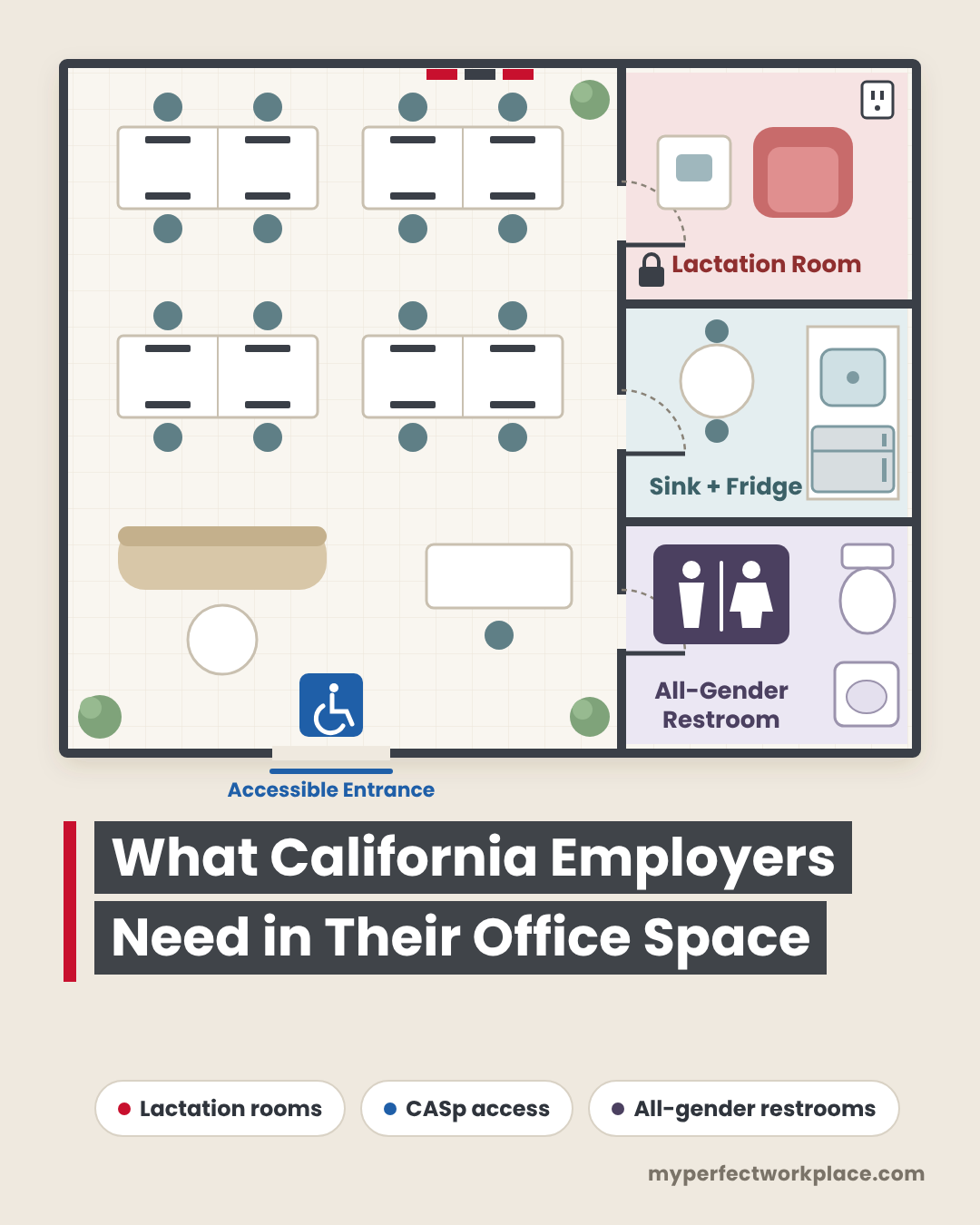

What California Employers Need in Their Office Space
Published At: Mon, 11/16/2026 - 12:45
Most businesses shop for office space on rent, location and square footage. But in California, the space you lease also has to work for the people you employ. Some legal requirements depend on the layout, the building, and what the landlord will build out for you.
It's far cheaper to plan for these during tours and lease negotiation than to retrofit after you move in. Here's what to look for before you sign.
1. A lactation space (and it can't be a bathroom)
California requires employers to give employees a private place to express breast milk. The rules are in Labor Code section 1031, and they affect your floor plan directly.
The space must:
- Not be a bathroom
- Be close to the employee's work area, shielded from view, and free from intrusion while in use
- Be safe, clean, and free of hazardous materials
- Have a surface for a breast pump and personal items, plus a place to sit
- Have access to electricity (or alternatives like extension cords or charging stations)
The employer must also provide a sink with running water and a refrigerator for storing milk near the employee's workspace. If a refrigerator isn't possible, another cooling device, like a cooler, can work.
What this means for your office search:
- Look for a small private room. A spare office or a lockable room with an outlet works. A multipurpose room (a small conference room, say) is allowed, but lactation use takes priority while it's in use.
- Check the kitchen or break room. You need a sink and a fridge nearby. In a small suite without a kitchenette, this can mean asking the landlord to add one as part of your tenant improvements.
- Ask about shared space in the building. In a multitenant building, an employer that can't provide a lactation room inside its own suite may use a space shared among the building's tenants. Ask the landlord whether the building has one before you rely on it.
- Smaller employers aren't simply exempt. A business with fewer than 50 employees can be excused from a specific requirement only if it shows undue hardship, meaning significant difficulty or expense. Even then, it must make reasonable efforts to provide a private space near the work area that isn't a bathroom or toilet stall.
Employers also need a written lactation policy, under Labor Code section 1034, and must provide reasonable break time to pump, under section 1030. For a plain-English look at the employee side of these protections, see Setyan Law's guide to pregnancy and maternity leave laws in California.
2. Accessibility: read the CASp statement in your lease
Accessibility matters twice: for clients who visit you and for employees with disabilities who may need a reasonable accommodation. Under California law, your lease should tell you where the building stands.
Civil Code section 1938 requires commercial lease forms to state whether the premises have been inspected by a Certified Access Specialist (CASp). Here's how it plays out:
- If a CASp report exists, the landlord must give you a copy before you sign. Fixing violations noted in that report is presumed to be the landlord's responsibility, unless you both agree otherwise.
- If the premises haven't been inspected, the lease must include a statement that you can request a CASp inspection and that the landlord can't stop you. You and the landlord negotiate who pays for the inspection and for any repairs.
What this means for your office search:
- Ask early whether the space has a CASp report, and read it before you sign.
- If there's no inspection, negotiate who pays for the inspection and repairs in the LOI, not after.
- On tours, look at the entrance, elevator, door widths, restrooms and parking. An accessible suite in an inaccessible building still causes problems.
If you have, or expect to hire, employees who may need accommodations, leave yourself flexibility in the layout rather than locking in a tight floor plan.
3. Restrooms and required postings
Two smaller items are easy to overlook on a tour.
- Single-user restrooms must be all-gender. Under Health and Safety Code section 118600, any single-user toilet in a California business must be identified as all-gender, with signage that meets Title 24. If your suite has a private restroom with gendered signs, ask the landlord to replace them as part of move-in.
- You need wall space for workplace posters. California and federal law require employers to post certain notices where employees can easily see them. Plan for a spot in the break room or near the entrance, especially in executive suites or coworking spaces where you don't control the walls.
Your checklist for tours and lease negotiation
Bring these questions to every tour, and settle the answers in your letter of intent:
- Is there a private, non-bathroom room that can be used for lactation, with an outlet?
- Is there a sink and refrigerator near the workspace? If not, will the landlord add them as a tenant improvement?
- Does the building have a shared lactation room for tenants?
- Has the space been inspected by a CASp? Can I see the report before signing?
- If not inspected, who pays for an inspection and for any repairs?
- Are the entrance, elevator, restrooms and parking accessible?
- Are single-user restrooms marked all-gender?
- Where will required employee notices be posted?
Get it in the lease, not after move-in
Every item on this list is easier to solve before you sign. Once the lease is executed, the landlord has little reason to pay for a new kitchenette or a converted room.
At My Perfect Workplace, our tenant representatives help you find space that fits your team and negotiate these items into your tenant improvements. Landlords usually pay our fee, so there's typically no cost to you. Call us at 1-888-518-9168 to get started.
This article is general information, not legal advice. Talk with an employment attorney about your specific obligations.